Selasa, 27 Desember 2011

At home in Singaraja

All I could see made me think we had just entered a small village set in gardens. There were stone paths with little paved gutters along one side, following the walls of a row of single storey bungalows as they went around a corner. A motorcycle or two was parked under a tree. The party of people split up, and Ibu led Yudhie and me along the path that turned a corner and stopped at a closed door in the last house in the row. She turned the door handle, opened the double doors and turned on the light—a magnificent, large, high-ceilinged room furnished simply with a pair of bamboo benches, a plant, and a couple of Hindu ikons hanging on the wall. Another room opened off to the right, but I didn’t take it in just then. My eyes were following Ibu’s every move, as she opened another door straight ahead. That door had a key. We entered another room and she turned on the light. ‘This is where you will sleep.’

I couldn’t believe my eyes. This room was also very simply furnished, very Spartan in its detail, with a large probably queen-sized bed, a wardrobe (which was locked), and a table with a mirror above it. The floor had a bamboo rug on one side near a large, unglassed window with ornate ironwork lattice and opened wooden shutters. The light in this room and the first came from a single fluorescent light bulb hanging from a cable in the ceiling. This seemed to be the norm everywhere we went in Yndonesia, from middle class townhouse to peasant cottage, and this comfortable and spacious bungalow somewhere in between. We put down our bags and followed Ibu as she opened yet another door, this one bolted from inside the room. It opened onto a breezeway that joined several ‘houses’ and was separated from an inner courtyard by wire latticework. Just outside our door to the right were the ‘facilities.’

This is where I got my first glimpse of what is normal in Yndonesia for toilet and bath. The bathroom in Yudhie’s apartment is almost American in layout, except for the drain floor. We have a normal toilet except there is a spray nozzle nearby along with the toilet paper roller, and both toilet and shower are in the same room. This is a ‘Western’ bathroom. What our house in Bali had was separate rooms for the toilet, and for the bath. In fact, they were actually separate little houses connected to the continuous flow of houselike rooms that comprise Ibu’s home. The kamar kecil, or toilet room, had a seatless toilet bowl, a water spigot with a bucket below it, a much larger water vessel off to the side with a handled cuplike pail, and finally, a roll of toilet paper hung on the wall by a makeshift wire. When you use the toilet, you flush it by pouring the bucket of water into the bowl and then refilling it.

I’m not going to describe the method of cleaning yourself after using the toilet because it’s just common sense. You either use toilet paper as in America, or water in the small pail and your left hand, or both. The kamar mandi, or bath room, is literally just that. The floor is a drain floor. The floor and walls and reservoir are tiled. There is a faucet above the reservoir which you use to refill the tank with as much water as you have used in bathing yourself. How do you bathe yourself, by the way? Well, it’s easy, and fun! Again we find that little pail that looks like a large measuring cup. You don’t hop into the reservoir, of course! The water is icy cold, even in hot weather. You strip down, then douse yourself all over starting with your head with cold water using the little pail. After you’re soaked, you use regular shampoo and wash your hair, soap for your body, and so on. Afterwards, you rinse yourself down the same way.

I came to love this type of bath even more than the baths in Japan. There’s something invigorating about using icy water. It wakes you up in the early morning. It cools you down when you bathe in the heat of the afternoon. It softens you and relaxes you in the night, getting you ready for night time pleasures, prayer, and sleep. While we were in Bali, and elsewhere, I bathed two, three, even four times a day. I never missed the hot showers I take when I am at home in America. It’s no wonder the people are so clean here—It’s so easy and refreshing to bathe. Looking back to our overnight stay in Nakao village in Sumatera, we can see how this type of bath evolved. There, a well in the front yard to draw water, a pony wall enclosure next to it with a drain floor, and a small reservoir in the wall which is filled by hand from the well. Dousing yourself with a pail, using shampoo and soap, that doesn’t change.

Ibu asked us if we thought the accommodation was satisfactory. We nodded respectfully and thanked her for such hospitality. After telling us that Titi would bring us a towel and some mosquito repellant, she bid us goodnight. We couldn’t help rejoicing in our good fortune. We’d never have hoped for such hospitality and comfort—our own house, and for the duration of our stay. After we bathed and settled in, we looked around our ‘rooms.’ Off the main entry room there was a dining room with table and chairs. A rack of plastic-bottled water, and a tray with two teacups and some teabags, lay on the table. I can’t quite remember if it was that same night or not, but several times during our short stay at Ibu’s food was brought us and laid out on the table. We were treated by Ibu and her family as visiting royalty. At the end of our stay as we were saying goodbye, she made certain we knew we could return any time.

Bali !

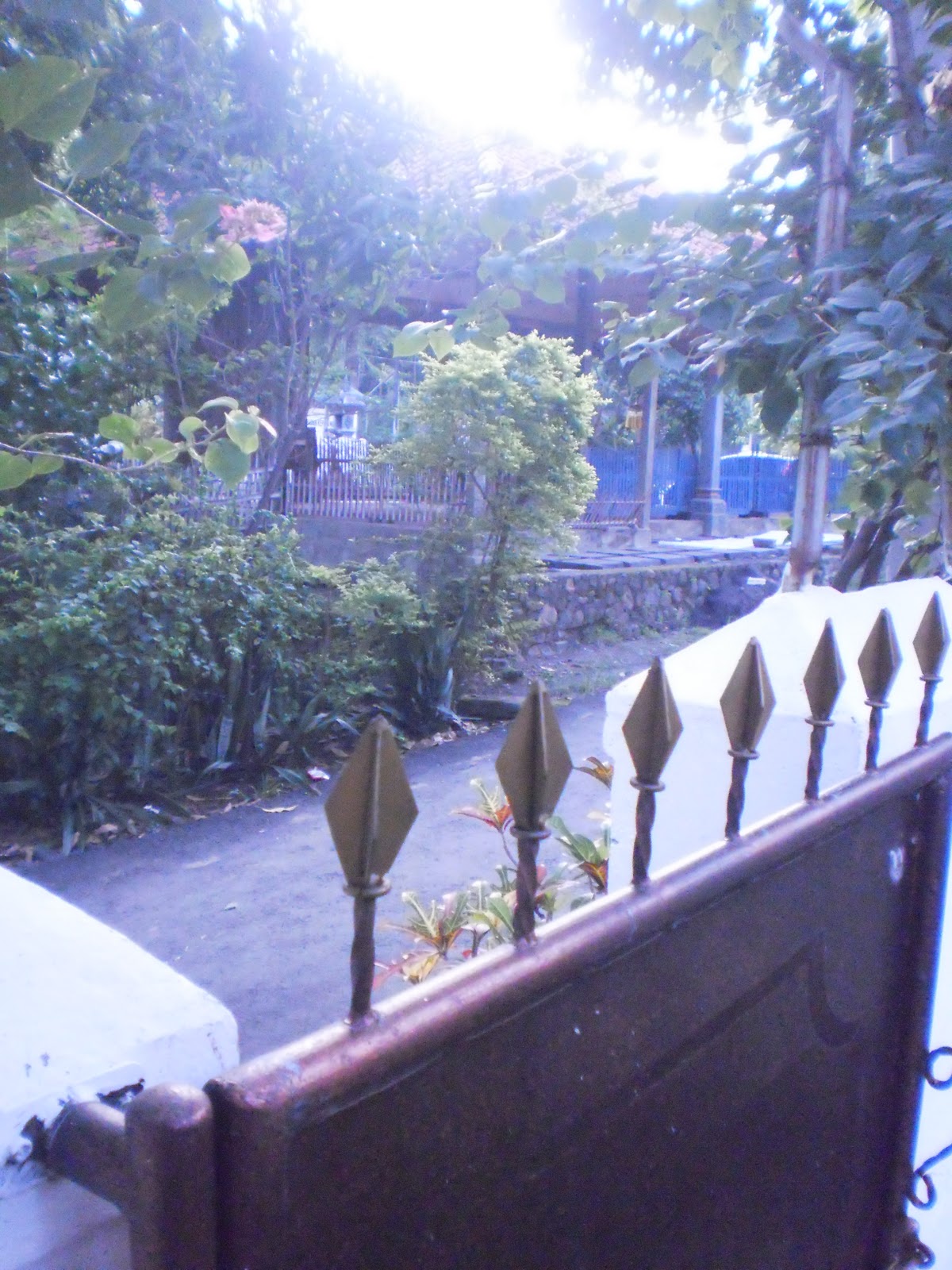
Ibu Anna's front gate, Singaraja
While I was at home in the States, my Balinese friend Anna Fedora heard I was going to Yndonesia for Christmas and, as she was also going home to Bali for the winter, she insisted that Yudhie and I come to stay with her and her family in Singaraja for as long as we wanted. Had I known what a truly wonderful place Bali is, I would have tried to stay longer. Definitely, next time we will. I wanted to visit her and meet her family, for Ibu Anna—Ibu means ‘Mother’ and in her case it is fitting, but it’s the ordinary formal title of women in Indonesia—is the first Balinese Orthodox Christian in the island, her family is the first to accept Holy Orthodoxy, and the first church is in her family compound. I wanted to see and photograph the Orthodox Christian pura that Ibu and her husband Lawry are constructing at Singaraja.

Gangway to our house at Ibu's
Originally I had wanted to motor across Java from Jakarta and take the ferry to Bali, but Lawry advised against it. The journey would be lengthy and possibly dangerous. Before I departed for Yndonesia, Yudhie booked two round trip tickets for us on Lion Air, so we could fly there. The airport is in Denpasar at the southern tip of the island, which meant that we would need to find a way to get to Singaraja. No problem. Ibu’s son Moda, who lives in South Carolina but came with his mother to Bali, would arrange to carry us to Singaraja by car. The flight took something between three and four hours, and when we arrived we were almost immediately met by Ibu and her family, Titi her daughter, and Moda her son, as well as an old friend and, of course, the driver, for Moda isn’t licensed to drive in Bali.

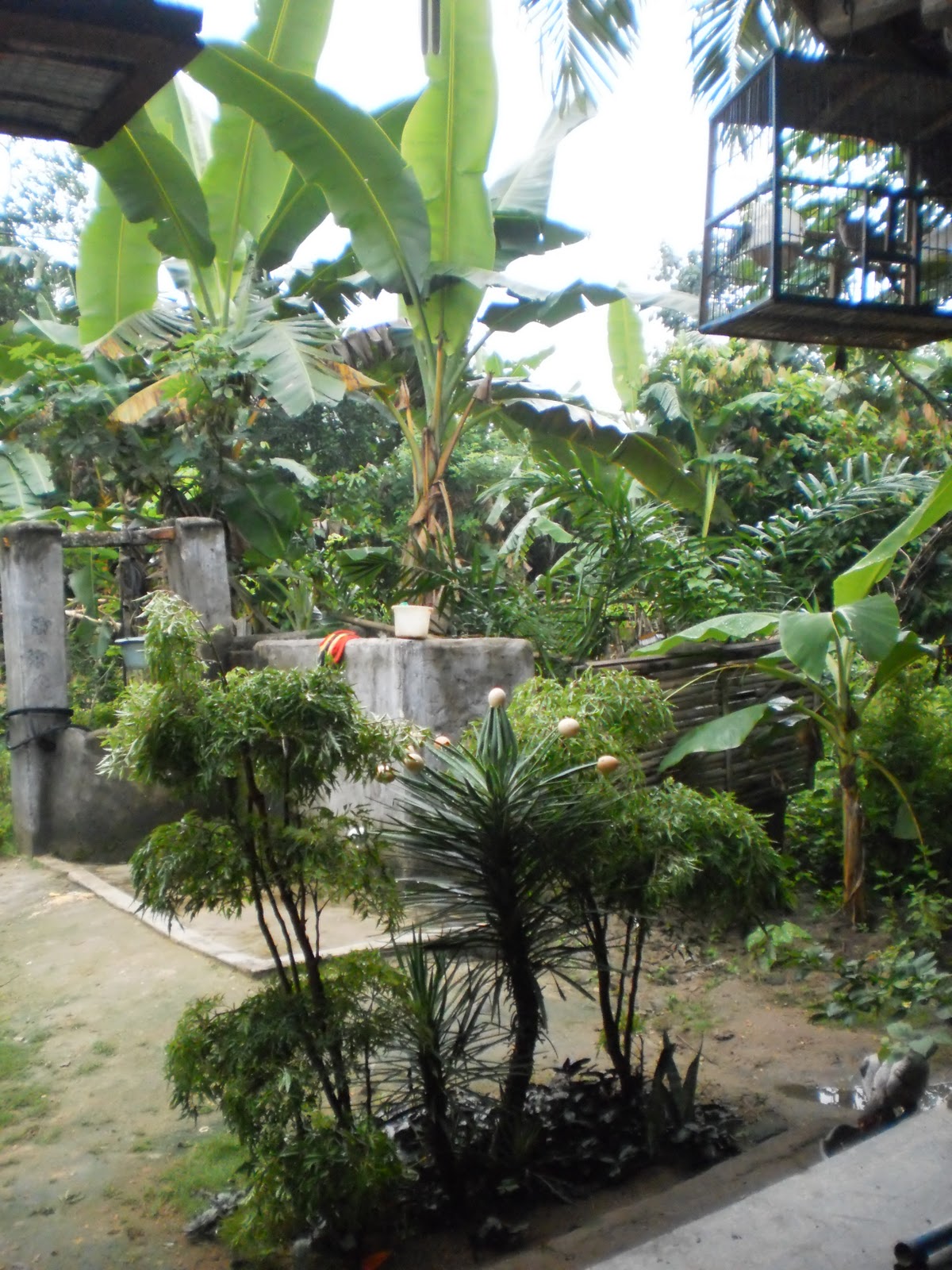
Garden at Ibu's house
The drive north to Singaraja took us through the mountainous interior of the island, the road curving back and forth on itself wildly a good part of the way, reminding me of some of the roads in Oregon. In fact, but for the tropical foliage of the forest, with all the ferns and tall trees the forests of Bali, and later in our travels, of central Java, the lay of the land was quite reminiscent of the American Pacific Coast rainforests. I thought that our plane would arrive early enough that our road trip would be mostly in daylight hours, but I miscalculated. Though it’s summer down here below the Equator, the days are only just slightly longer, and the sun sets at most half an hour later than usual around the summer solstice. We had the pleasure of driving those winding mountain roads in the cool, starlit night.

Kambing saté
Gado-gado

Soto ayam
Ibu must have thought we were very hungry, us after our long flight, and them, after coming to fetch us home from the airport, so as we began to enter the neighborhood of Singaraja, we stopped the car and entered a rumah makan, an eatery, for some supper. Though the island of Bali is inhabited mostly by people practicing the agama of Hindu Dharma, there is a sizable minority of Muslims. This restaurant was operated by a Muslim family, as we could tell from the beautiful displays of Islamic calligraphy and images of the Muslim holy places that hung tastefully on the walls. That also meant that we would not be served any dishes that contained pork. Dinner was scrumptious—and I was introduced to a meat I had never tasted before—kambing saté, goat skewers. We also had rice, a delicious soto ayam, chicken soup, and a dish that we met everywhere we went, but always a little different, gado-gado.

The outer courtyard with the balé, right
After the meal, we only had a short drive to make for home. I was in suspense because I didn’t know a thing about houses in Bali. I had pictured wall-less grass-roofed arbor-like structures furnished with bamboo chairs and tables, with rattan hammocks hanging from posts. The only film I’d ever seen about Bali is Eat, Pray, Love, where the leading actress stays in a villa in the island that was rather more like an arbor than a house. As we drove through the streets of Singaraja, even though it was night, I could see large buildings and beautiful houses and gardens surrounded by walls. I saw large flood-lit statues where the major streets cross each other, so I thought we must be almost home. Ibu’s house, I was told, is very near such a monument. But our first stop was not home. It was to drop off the old friend first. Her house was a solid masonry house with fancy doors and windows, and a garden surrounded by a high wall.

The stairs descending to the outer courtyard, by day
When we stopped, I thought it was Ibu’s house, and it was a bit of a let down when I realized what was going on. But I recovered quickly and was even more excited than before. Yudhie had never been to Bali either, except to pass through on his way to Java from Sumbawa, an island farther east where he’d lived when he was in high school. We seemed to be driving in circles, but maybe it was only my tired imagination. There was that big statue again. ‘We must be getting close,’ I thought to myself. Then suddenly the car took a sharp turn to the left and we entered a narrow, tree-lined lane, stopping in front of a wrought iron gate in a wall. ‘Everybody out!’ Nobody said anything, but there was a concerted effort to gather our things as we poured out of the doors of the car. It was very dark, but light came from somewhere, street lamps, I think. Ibu opened the gate, and down we went a flight of stairs.

Sabtu, 24 Desember 2011

Natal di Indonesia

Nativity Ikon in the church of Aghía Epiphanía
The doors! The doors!
Christmas in Yndonesia.

What better place to celebrate the birth of Jesus Christ than in a land where most people know of him, but don’t know Him? What do I mean? Well, this is the land of mosque and minaret, where five times a day starting at four in the morning the unearthly cry of the mu’ezzin calls the people to prayer. They know of Jesus Christ as Isa al-Masih, second to last prophet of al-Islam. I’m using Arabic words now, because in bahasa Indonesia He’s called Yesus Kristus, the Christian name for Him. But when a Muslim thinks of the One we call Jesus, they call Him ‘Isa’ and regard him not as God in the flesh, but as a prophet, born of a virgin, and taken into heaven. Strangely, they also call him kalimat Allah, ‘Word of God.’

Entrance gate to Aghía Epiphanía
Islam believes in the annunciation to Mary by the angel Gabriel and the mystic, virginal conception of Jesus. It believes in what it calls al-Injil, ‘the gospel,’ but it is not the same gospel that Christians believe. Our gospels are, from Islam’s point of view, corrupted. That’s why Muhammad had to come and restore the truth of al-Injil, which is none other than the truth of al-Islam, ‘submission [to Allah]’. Islam also does not believe that Jesus was crucified, nor that He died, was buried, and resurrected on the third day. ‘Impossible! Allah would never treat His holy prophet Isa like that!’ No, of course not. God is faithful. Even if Jesus were not His Only-Begotten Son, He still wouldn’t sentence him to death on a cross.

Aghía Epiphanía Orthodox Church
So, Islam believes in Christmas but not in Pascha, not in Easter, not in the resurrected—but only in the ascended—Lord, no, not Lord, but prophet. There is only One God, Allah, and He has no partner. Not a wife, not a son, not even a friend… No, He does have a friend, yes, maybe a few. The prophets, for sure, and even people like Muhammad’s son-in-law Ali, who is called ‘friend of God’ and who, oddly enough, suffered and died not unlike Jesus, except that nobody in Islam ‘dies for the sins of the people.’ There is no such thing as atonement. If you’re chosen by Allah, you’re saved. If not, you’re damned. It’s as simple as that. Try to live righteously anyway, because there will be a Judgment. On that, all agree.

Ikonastásion and Soléa
Back to Christmas in Yndonesia, where Christianity in two of its forms is one of six recognized faiths: Islam, Kristen Protestan, Kristen Katolik, Hindu, Buddha, and Khonghucu. The last named faith is Confucianism, the latest to be added to the original five. Yudhie and I, as well as our friends in Bali, are (Eastern) Orthodox Christians, as yet an unrecognized faith, and so slightly illegal. How slightly? Well, it depends on which direction the wind is blowing. In some places in the country, Orthodoxy is left alone, in other places it is molested. As it is, the church Yudhie and I belong to, the Greek Church, even in Yndonesia, has a certain amount of respect that keeps it out of trouble, usually.

Naós - The nave
The Christmas liturgy was going to be held on Christmas Day, but then Yudhie got a text message saying that they had changed the time to December 24. It seems, that day worked out better for most people. Our church, Aghía Epiphanía, Holy Theophany, is in Jakarta in an undisclosed location for reasons of security. The building has a blue dome and looks like a church to us, but it is unmarked by cross or name, and it is classified as a multipurpose structure. It really is a beautiful building inside and out, as you can see from the photos, and is lacking nothing that an Orthodox temple has in America or Europe. The congregation comes together from all over the Jakarta metropolitan area.

Outdoor baptistry, for triple immersion baptism
We rented a car with driver for the whole day. He picked us up, drove us there, then took off while we were in the service, and came back to pick us up afterwards to take us home. When Yudhie goes to church on Sunday, he and Johnson, his fellow teacher who is a catechumen, ‘under instruction to become Orthodox,’ take the bus into Jakarta to go to church and return home. Because it was Christmas Eve and we didn’t want to take a chance at missing the service or be stranded due to a shortage of taxis (as happened to us on New Year’s Eve), we hired the car. We were worried that rush hour traffic would make the journey a two hour trip or longer, so we left early, and ended up being too early.

Aghía Epiphanía from the back, blue dome faintly visible
No problem, because we were able to help with some of the preparations. One thing we had to do was erect some pavilions in front of the church for our ‘police protection.’ This is one of the facts of life for Christians here—there’s always a slight risk in going to church, because militant Muslims sometimes molest church goers. The local police insists on being ‘rented’ by churches to ‘protect’ them from possible violence during holiday services, and they have to be duly and honorably lodged, hence the pavilions. Our police protection didn’t show up until well after nightfall and the service had been in progress for some time. There really was no danger. Most Muslims in Yndonesia are not militant.

Yudhie
Because we arrived early, as I said, we helped out, at least Yudhie did, straightening the hangings on the ikons, helping the sacristan set up for the services. As a foreign visitor I was mostly made to sit down while people brought me tea and snacks and engaged me in conversation. That was, for me, one of the most pleasurable experiences of coming to the church. I also met and had great fellowship with the youth pastors, especially Oziel, who was Yudhie’s sponsor when he was chrismated (joined) into this church. People of all ages and walks of life came and talked to me, most of them in excellent English. This is a middle class congregation for the most part, to whom English is second nature.

Fr Gabriel
None of the photos in this post were taken during the service. I remember taking a few photos during the service, but either we lost them or forgot to download them. One of them was of the choir, of which Yudhie and Oziel are members. Too bad, but it is almost impossible to take photos during a service. That’s not what we’re there for. Fr Gabriel, whom I met when he first arrived wearing street clothes, reminded me of an athletic coach. He is very dynamic and focused, yet very approachable and has the gift of rapport with people of all ages. His celebration of the liturgy is also energetic and intense, quick and lively. ‘This is how liturgy should be celebrated!’ I couldn’t help saying to myself.

Youth choir
Before the liturgy began, there was, as in most churches, a Christmas pageant and music performance, which took place on a stage facing outward into a sheltered area on the side of the church. Fr Gabriel told the story also of Saint Nicholas, the ancient Church father who in the Western world evolved into Father Christmas and Santa Claus. This is a universal practice in Orthodoxy—reclaiming the saint from the santa, and helping the children understand his historic reality and spiritual meaning. That doesn’t put a stop to gift giving or dampen the ‘Christmas spirit.’ Instead, if done properly, it puts everything in perspective, and gives kids a foundation to build on that doesn’t come from modern myths.

Oziel with youth group
What else? It’s very hard to describe what goes on in the divine liturgy, especially during holy seasons like Christmas and Easter. You just have to be there. Other things I noticed, as ‘an American in Paradise’ was the real friendliness and camaraderie of the congregation. There was absolutely no one left out at any time. People were constantly involving each other in various ways. As is usual in Orthodoxy, the kids had freedom of movement yet a respectful attitude. Very close, next door in fact, was a very large evangelical church that was also celebrating. Because of the heat, all our windows were open, and the sound of our neighbors partying was mixed with the sound of our hymns. A strange combination.

Bishop's seat
Even stranger was the sound of the mu’ezzin from a nearby mosque chanting the call to prayer. At first it seemed to be an intrusion in our liturgy, but after awhile one didn’t hear it anymore. Our ears just tuned out the competing sounds of Christian partiers next door and Muslim chanters across the street. ‘This would never be tolerated in America,’ I thought to myself. But here, what I noticed is how people don’t just put up with people, grudgingly, they almost seem not to notice when their space is being impinged. Maybe this is what comes from living in close quarters day in, day out. Jakarta has to be one of the most densely populated places on earth. It does feel crowded. But to me crowded doesn’t feel oppressive.

Outdoor prayer niche
Before the service, and after, people were encouraged to feast. This surprised me, at least the feasting before the liturgy, since we fast for a minimum of six hours before receiving the holy mysteries. I asked them about this, the eating and drinking before the service, as this never happens in America, and I was assured that it was allowed just on this day, as an ikonomía, a dispensation. Ordinarily, I was told, they follow the universal Orthodox custom. The various hardships that people endure to be able to come to church are compensated somewhat by the relaxing of various rules that obtain in the West, where being a Christian and going to church are almost effortless. Once again, reason and love rule here.

Jakarta neighborhood street
When we arrived home it was almost midnight. We had the rental car for exactly twelve hours, from noon to midnight, and we were a little concerned that we might exceed the twelve hours, because if that happened, we would have to pay for another twelve. The driver was an honest man and delivered us to our door even more quickly than he brought us to the church. Of course, there was little traffic at that hour, and I finally got to see the freeway uncrowded by motorcycles. Traffic at half past eleven on Christmas Eve was almost at a normal, not rush hour, concentration. So we arrived home safely, well-fed by both earthly and heavenly food, and our coach did not turn into a pumpkin. A merry Christmas, indeed.

Johnson, Irini, and Oziel
The next two days, Christmas Day and Boxing Day (what the day after Christmas is called in the ‘Great White North’—Canada) were days of rest for Yudhie and me. We got to know each other some more, practiced living together, and got ready for the next trip on our itinerary, on Tuesday.
And that would be… Bali !

Jumat, 23 Desember 2011

On the road again

Now the light in the next room abruptly clicks off, and I notice for the first time how light it actually is outside. I never sleep in, at least, not usually. To wake up and find daylight all around me always makes me feel like I’ve wasted the best part of the day. I gaze over at my son Yudhie, sleeping, as usual. He needs more sleep than I do, because he has such a long road to travel, whereas for me, the road is almost at its end. Therefore I sleep almost not at all anymore. I carefully slip out of bed, pull on my trousers, grab my shirt, and go out to take my shower. Well, that’s one way of putting it, but I do not actually take a shower.

Yes, this is how you do it… it all starts with water from the well!
Unnoticed by the habitants of this paradisiacal spot, I draw buckets of water from the well, fill the reservoir as I was shown the day before, then douse my head and upper body with icy cold water using a plastic bucket. I wash my hair, my head and my body from the waist up, standing behind the wall that encloses the privy next to the well. This is the most basic form of bath in Yndonesia, and we will see it time and again everywhere we go, though usually more sophisticated, and indoors. I dry myself off with a towel and put my shirt back on.

Hen with new brood
Granny appears from somewhere all excited, and wants to show me a hen with her newly hatched brood, which she has isolated in a special basket in front of her little store.

Now Yudhie appears at the doorway of the cottage. It’s his turn to use the facilities. Yes, sometimes we also have to use the toilet as well, and I haven’t explained about that. Well, there’s not much to tell.

Out here in the countryside, the little privy at the well is also used to relieve oneself, and the floor of it is a drain floor. You can’t take a dump there, of course. To have a bowel movement, you’ll have to go into the bush, find a secluded spot, try to have it cleanly, then return to the privy, unclothe your bottom and wash, always using only the left hand. And that explains why, in Asia and other ancient lands, you never offer your left hand, or anything in your left hand, to anyone. From Greece to New Guinea, and everywhere in between, it’s the same.

Typical country road
We sit down together and have breakfast. The night before we talked about how we would return to Lampung town. Yudhie and I really thought it was too much to expect Riyanto to take us back. The outbound journey really was quite arduous, and we’d hoped we could hire someone with a car to carry us back to the airport. So, Riyanto went out in the dark evening to find us a driver. There was one, of course, but when we called to say we were coming, he hadn’t had enough time to arrange anything. Fortunately, a driver was found. This morning, we had only to get our backpacks on after breakfast. Riyanto and his wife accompanied us, she dressed for the mosque, as it was a Friday.

On the drive back to Lampung we saw many things, too many to photograph, even had we tried. As one interested in architecture, construction and design, my eyes feasted on the native crafts of home building. Scaffolding constructed entirely of bamboo poles of various lengths and thicknesses surrounded new homes being built, as we passed them on the road. I marveled at the artistry of windows and doors, to me the essentials that make or break the design of a house. Having stayed in and closely inspected Riyanto’s cottage, I got a good idea of how to build an Yndonesian house. Yndonesia is a land of brick, or at least originally it was; now what I call cinderblock is chiefly used.

These pengamen, street musicians, are not the ones that we saw in Lampung,
but they are performing their music the same way
Thinking back to our first bus ride, I encountered for the first time native troubadours, called pengamen. Two of them boarded our bus at Lampung as it was waiting to be filled with passengers, they played guitar and sang native songs beautifully, then passed an envelope for donations. It was my first time and I didn’t know any better, so I plunked a pile of rupiah coins in the envelope, maybe 2,000 rupiah worth. I’m sorry I didn’t give them more, even 20,000 rupiah—two dollars—wouldn’t have been too much. Coins, as I learned afterwards, are received in change but rarely given in payment. I’ll explain why later.

Lampung airport
Soon, the land rover that was taking us to our destination, the Lampung airport, finally got us there. Now, it was a bit of an awkward moment for both Yudhie and myself. We had already paid the driver for bringing us and of course returning to Nakao, but now it was time to say goodbye to Riyanto. It must’ve been strange for him to see his only son, but the son he gave up at birth, going away again with someone he had heard about and had only just met, but who was now, mysteriously, part of their family. He joked about my identity to his neighbors, saying I was his son’s ‘father-in-law.’ What else could he say? But the parting went well. Yudhie, with the humble gestures of a son, offered Riyanto a paper envelope containing a gift of money as a Christmas present. Next, I offered my paper-wrapped gift, saying to him ‘Selamat Natal’—a merry Christmas—and ‘Terimakasih’—thank you—then, we picked up our gear and headed for the ticket counter to have our boarding passes printed.

Yudhie and Ayah in the Sumatera countryside, near Nakao, Lampung

Kamis, 22 Desember 2011

Inner Light

The sound of the mu’ezzin, prerecorded and wafting in from a nearby mosque loudspeaker, the call to prayer, in Arabic but in a melody unlike the Middle Eastern tune I learned, was a constant and predictable intrusion. Even watching television—yes, even in Nakao Village, they had television and, I supposed, a satellite dish—a popup appeared on the bottom of the screen at prayer time, but I never saw anyone actually pray. Yudhie says that Granny is very devout and lives like a nun. He showed me her tiny room, and he was right. She has it set up as a prayer room with a small cot. Though she doesn’t understand Arabic, she prays in the language just the same. At prayer time, she just disappears.

Before it got dark, Yudhie, Riyanto and I took a walk. I think Riyanto wanted to show us the land, and also show us to his neighbors. We saw the little pond where he fishes for the family’s meat, and the rice paddies nearby. We passed a few neighbors’ homes and spoke greetings. As evening wore on, we walked to a corner store and sat on the veranda talking to the owners and their little boy. No one spoke English, but a few words here and there. Everyone was pleasant and soft-spoken. Never did I feel unwelcome. In the evening, a relative who was a Muslim elder stopped by and spoke to me a little, asking where I was from. I got the feeling that most of these people had never seen a bulé up close.

Campaka flower
Nightfall, my first night in the real Yndonesia, the land where the night air is scented with the perfume of campaka and jasmine, where we are serenaded by softly croaking frogs in the rice paddies, or the rising and falling shrill of crickets, where calm is the night, like it were made for the whole world’s sleep. The modern world still penetrates even the remote countryside. Somehow Riyanto got another temporary circuit rigged up with a light bulb attached, which he hung up in the bed room Yudhie and I would share. What looked like a queen size bed filled the tiny room. A crude shelf hanging from the wall was where I laid my glasses when I went to sleep, Yudhie between me and the wall. Clean, quiet.

We turned off the light bulb and settled down for the night. Yudhie sleeps deeply, I sleep almost not at all, or at least, very, very lightly. At precisely four in the morning, I am awakened by the loud crowing of a cock somewhere outside, but far off. Then, almost without a break, about a dozen or more other likeminded fowl began amusing themselves at my expense, one of them crowing to wake the dead right outside my window. Then, the mu’ezzin starts up, and a soft but persistent Arabic chant calls the faithful to prayer, and there I lie, happily staring blankly but resignedly—and contently—up at the heavy beamed rafters, counting the slats between the roof tiles that are admitting the faintest light, as so many ‘windows to Heaven.’

I hear the slight sound of others moving about in the cottage, but it is still dark. Soon, though, the light bulb hanging from the ceiling in the next room, which is the room where we sit to eat, socialize, and watch television, is turned on, casting a reddish glow on the rafters above my head. The walls of the rooms do not go to a ceiling, but end where a ceiling would be if there were one. Someone is out in the yard drawing water now. I hear the clank-clank of the chain that pulls the bucket up from the deep well. Water is being poured into the reservoir from the bucket, and then into other buckets, and brought in.

The women are up in the pre-dawn darkness starting their chores. The mu’ezzin has fallen silent, and I hear what sounds like the scrubbing of the cement floor in the next room, a sound rhythmic and almost musical. Silence reigns, as far as human speech goes, but yes, the cocks are still crowing with stubborn regularity. Are they having a competition out there? More water at the well being brought up, I can hear the chains rattling. Now, it must be food preparation. I hear the sound of chopping. Are vegetables being chopped for our breakfast? Yes, here too we will eat what I soon learn is the breakfast food of Yndonesia—rice, rice and more rice, with veggies and fish and other tasty things, of course.

I listen and I look, my ears and my eyes growing more and more accustomed to what are no longer strange surroundings but rapidly becoming home for me. Yudhie beside me is sleeping still through all these sounds and sights. I would wake him to share this experience with me, but I don’t. I know that to him this is what he has known most of his life. It wouldn’t sound or look to him as it does to me. I let him sleep, even ‘when morning gilds the skies, my heart awakening cries, may Jesus Christ be praised!’ Yes, that Christian hymn starts unwinding its strains in my mind, and my lips silently sing it. Then, with the scripture, ‘This is the day that the Lord hath made, let us rejoice and be glad in it,’ I simply thank Him.

At home in Nakao

Home of Riyanto and his family, Nakao Village, Lampung
Our motorcycles pulled in at a neat little cottage made of cinderblock, roofed with terracotta. As we dismounted, people started pouring out of the house. Riyanto’s wife and her mother, as well as other relatives and friends. It was hard to know who was who at that first meeting, and I never did quite understand all the relationships, but we were met with a gentle and gracious kindness—I should say, I was met—for I was the stranger, and probably the strangest person some of them had ever seen. Yudhie introduced me to his step-mother and step-grandmother, but there’s no such thing as ‘step’ among them. Granny looked at Yudhie with as much love and pride as a natural grandson.

Hen and chicks, not the Garuda,
should be the national birds of
Yndonesia
Protocol, yes, even—no, especially—in a rural village. The front room of the house, the door left open, the only windows with glass in them, that was where we left our sandals, to enter the other rooms of the home barefoot. I noticed later that the motorcycles were also parked in this front room. The door left open allowed hens and chicks to come running in and out as they pleased, but no one seemed to notice. We men sat down around a table, while the women brought snacks, then rice and cooked food. Something that tasted like grape Kool-Aid with ice was brought in a pitcher along with glasses. The guide books all warned, ‘Don’t drink iced drinks. The ice could be from tap water.’ I shrugged and drank.

As it turns out, even in a small village where electricity comes into the house by a single wire that taps into the power line following the road, people know how to live clean and healthy. There, standing in a corner of the room was a water cooler like you’d find in any office, loaded with an inverted five-gallon plastic bottle of water. ‘I’m not gonna die after all,’ I breathed a sigh of relief. Remember, all this was very new to me. I hadn’t discovered yet that the guide books are warning tourists what not to do. I wasn’t a tourist, but a returning family member, and if my family could eat or drink something, it was safe for me too. Following this rule, sometimes against my common sense, I came to no harm.

There’s almost too much to tell, even about this short visit. Though daylight lasted only a few hours, it seems like we did and saw so much, more than can be described. Riyanto, though a Christian, was married to a Muslim, and so the house was full of cats. He sometimes threatened to do away with them—they were so many—but he never did. He is a gentle, quiet man, a little younger than me, who works on motorcycles for a living. His customers bring their sick cycles to him, and he heals them, squatting in the yard, using tools that’d be thrown away in America, with an ingenuity that puts formal training to shame. Boys and men stopped by all day, maybe to fix cycles, maybe to see the stranger.

Yudhie took me on a little tour of the house after our ceremonial first rice had been eaten together. The women had never joined us, but brought the food and drinks in, and removed them when we were finished. He showed me the kitchen, a very large room at the back of the house, whose back wall seemed to be made of woven bamboo rather than cinderblock as were the other walls, even the interior ones, in the house. The kitchen was absolutely medieval, with a raised floor at one end, and many kitchen tools I had seen in museums of ancient history. There were windows in the house, covered by woven bamboo shutters. In spite of the simplicity and poverty, everything seemed clean.

Despite the warnings that Indonesia would be crawling and swarming with insects, I almost never saw any, not a single roach, maybe a handful of flies—literally—and of course, a scattering of mosquitoes—I came away with perhaps a dozen bites. I saw plenty of ants indoors, anywhere you left food or sweets uncovered, they would invite themselves, but so tiny that you could scoop them up with a paper towel as if sweeping up spilled poppy seed, and throw them away. Riyanto’s women had caged song birds hanging in the front porch, or perhaps they were his, I never asked. I couldn’t figure out how everyone knew whose chickens were whose, but asking, was told, ‘Yes, we know which are ours.’

Granny with the ‘Big Bulé’ in front of her store, Nakao Village
Granny has a little store built at the edge of the roadside. There she sells small treats, fruit, and drinks, little gadgets and anything else she can find. Sometimes she even sleeps, or at least naps, in her little store. It has a single low bench in front of the window and under an overhang. Yudhie and I sat there as she patiently showed us the ‘right way’ to peel and cut up a mango, which we then shared between us. Literally, mangoes and rambutans and other fruit simply fall off the trees everywhere you look. It seems that almost every family in this village has a little store or shop of some kind on the road in front of their property. In Yndonesia, it seems everyone always has something to sell. It’s free enterprise run wild.
Next… Inner Light

Sumatera!

Lampung, Sumatera from the air
It was almost Christmas. We had talked about the possibility of visiting Lampung, the southernmost province of Sumatera where Yudhie was born and grew up, but we weren’t sure exactly when we could go, or how we would get there. Sumatera is the large island west of Java that extends northwest and borders the Malayan peninsula. Lampung is the province opposite Java, separated from it by a narrow strait dotted with volcanic islands, the most famous of which is Krakatoa, which detonated in 1883 and killed at least forty thousand people. Yudhie’s dad, Riyanto, still lives in Lampung, but is remarried into a Muslim family in a small village in the interior. We were going to visit them for Christmas.

Yudhie and Riyanto
When Yudhie was born, his dad disappeared from the family, and he did not find him again until he was a young adult. Growing up, he was raised by his mother, who was an invalid and died when he was fifteen, and then his older sister and some female relatives tried to take care of him as best they could. Yudhie had visited his dad a few times since they were reunited. It is a slow and lengthy journey by buses and ferries and motorcycles, taking at least one full day going and another coming back. After we came home from our trip to the mall, we weighed all the possibilities. Since we had the resources, we decided to fly to Lampung, and then arrange the final travel to the village of Nakao.

We bought two round trip tickets from Jakarta to Lampung and back, online and with the assistance of Yudhie’s brother-in-law who is a travel agent, living on the island of Timor, far to the east. Then Yudhie called his dad to tell him we were coming on the 22nd, visiting, staying one night, and returning on the 23rd. It doesn’t seem like a very long visit, but honestly, it would put the family in some difficulty for us to stay longer, and the visit was somewhat ceremonial, paying respects at Christmas time, and bringing some gift money. Yudhie also wanted to show me where he grew up, but when we got to his dad’s place, he decided that it could not be arranged. So we just enjoyed being with the family.

View from Riyanto's front porch
The flight was uneventful, other than the fact we were crowded into a plane with other holiday travelers probably going home to villages in Lampung as we were. Upon arrival, Yudhie navigated us by angkot and bus to an intersection on the edge of Lampung town where we were to meet Riyanto and a friend, both waiting with motorcycles to take us to Nakao village. This was going to be a real adventure for me. I hadn’t been on a motorcycle since I was a nineteen year old college student over forty years ago. Would I survive the voyage? I wondered. At our rendezvous point, there was Riyanto, waiting patiently with his friend. Both were clad in full motorcycle gear, leather jackets, helmets, the works.

Yudhie sitting in front of Granny's ‘store’
They had been waiting for us for a few hours! Our plane had been delayed in leaving, but we couldn’t reach them before they had hit the road. Nakao village was more than two hours away over mostly unpaved, dirt roads full of pot holes you could drown in, and all loaded with traffic going both ways, cycles, cars, trucks, even the occasional ox cart. After making our introductions, we each hopped on the back of a cycle, me tucked close behind Riyanto, two dads riding together, and Yudhie with the younger friend of his dad. Luckily it was sunny and not rainy. I wore only the short sleeve shirt you see me wearing in the pictures. Dust blowing at me at fifty miles an hour was the only discomfort.

Granny out for a walk, Yudhie sitting in front of her ‘store’
We stopped for gas. Motorcycles don’t use much, the gasoline costs only 4,500 rupiahs per liter, that is, about two dollars a gallon, and it is sold from a government franchise. While they gassed up, Yudhie and I went into the convenience store and bought a couple of big bottles of Sprite. Indonesia is Sprite and Coca-Cola country, not Seven-Up and Pepsi land. We took a few drinks and then climbed back on the cycles and took off. The roads were for the most part unbelievable. The ruts and holes were more normal than smooth pavement, many of them still full of water from recent rain. I held on to the cycle and Riyanto and moved like a horseback rider jumping hurdles. It was dangerous, but fun.

Nakao Village, North Lampung
By now, we had left ‘civilisation’ behind, for sure. That gas station was the end of it. Now, in the country side, it was mostly ox carts and motorcycles, along with foot traffic. Native-styled, beautifully and solidly built cottages met us by the minute in clusters. About every ten minutes—I am not exaggerating—we passed a mosque with its loudspeaker mounted on a tall pole. Colorful hens and cocks crisscrossed the road in front of us. Riyanto successfully avoided all of them, but one. ‘Someone will have some ayam goreng tonight,’ I hoped. Besides all the mosques, we knew we were in Muslim country because of the cats. The prophet’s favorite animal, they say, and so they love them too.

Ayah and Yudhie arrived safely
At last, we were turning into a dirt drive way. It was a church! And we drove in alongside the church and stopped, Riyanto talking to his neighbors and friends without getting off the motorcycle. They all smiled and looked happy, as well as amused as I think Riyanto was telling them of his hair-raising ride with the silver-bearded bulé that his son Yudhie had found somewhere and was bringing home. I noticed here that the men and boys smiled and laughed, something I hadn’t noticed much the day before in Tangerang.

‘Now, this must be the real Yndonesia,’
I thought to myself. We met up again with the other cyclist carrying Yudhie, and we drove the next few hundred meters to Riyanto’s place.

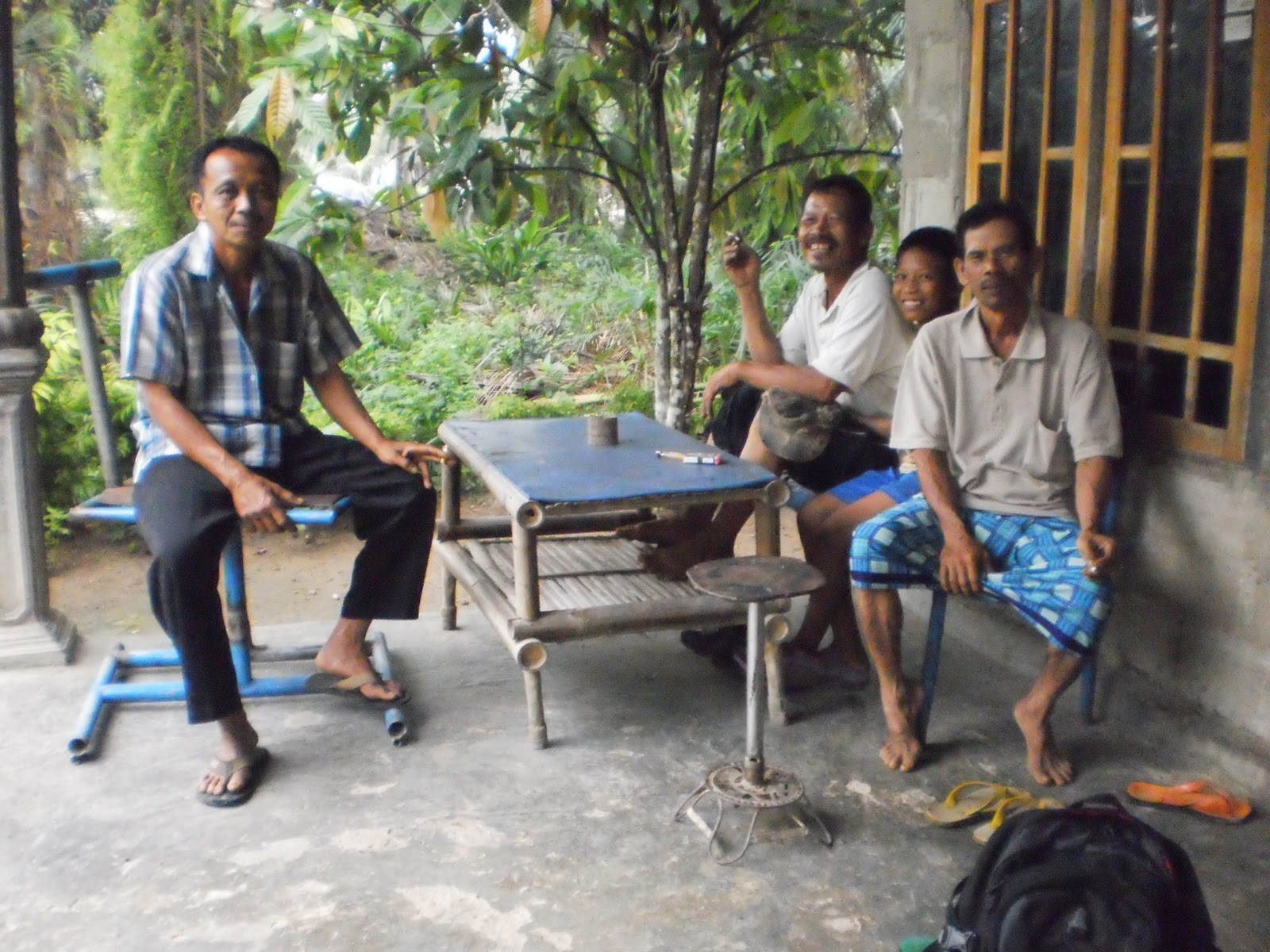
Neighbors hanging out at Riyanto's house, Nakao Village