Senin, 02 Januari 2012

At home in Purwokerto

Traditional style windows in the upstairs family room.
After Dwi’s father came home and we all became acquainted, it was time to take us around and meet some of the relatives. Andreas actually had to visit his doctor and get a prescription, so he took us along, thinking that it would be a quick trip, but the doctor was late for the appointment, so we had to kill some time. Since it was close by, we went to visit one of Dwi’s aunts who runs a beauty salon. It felt strange to be going into what I’ve always thought of as a ‘women’s world,’ but people there don’t seem to notice such things. Auntie’s beauty salon was just an extension of her home, and another place to show hospitality.

We entered the salon and were introduced by Andreas. This was, I think, a surprise visit for Auntie, her employee, and her customers, but they didn’t seem very busy, so with us men seated on two couches and the ladies sitting about on salon chairs, we struck up a conversation—at least those who could speak bahasa did. I listened very closely to see how much I could catch, and interjected little bits of bahasa when I was asked a question. It really was a great experience, just like being with my own relatives when I was a child. Family, and especially extended family, is very intact here.

After awhile, Andreas returned and we began the process of rounding people up to go to dinner this evening. It’s amazing how many people we were able to fit in his car. Auntie and some other female relatives came and then we returned home and picked up the rest of the family. Night was coming on quickly, and so was the nightly thunder shower. It started raining as the last bit of sunset light vanished behind the tiled roofs of the houses we passed on the way to the restaurant.

The streets we passed through would seem like narrow alleys to Americans. This city is definitely laid out in the Asian, maybe traditional, pattern. I haven’t been to Europe, but I imagine this is also how it is in old towns there. The American pattern of wide streets and boulevards is a luxury of a land with unlimited space. Personally, I like the coziness, and the mystery, of these ancient alleys, where suddenly after meters of uninteresting walls and gates, you might come upon the most splendid, hidden entrance to an even more interesting house or shrine.

We reached our destination and quickly ran inside the restaurant for cover. The rain was beginning to pour now, not just drizzle. A few faint thunderclaps were heard. I wish it were day time, so I could see exactly where we were, but the night and the soft glow of the lamps made the complex of unwalled pavilions, interspersed among ponds and gardens, a dreamlike wonder. We were seated at the long table in the picture. Really, the table was too big for us, and after seeing how we had accidentally divided ourselves at the two far ends of it, we moved ourselves more evenly around it, so we could be near each other. I had the pleasure of sitting next to Eko (while he told the story that follows), whom I already knew from our exchanges on FaceBook, even before I knew he was Dwi’s brother.

Eko is a very interesting young man, about twenty-six years old. He works with his father in a wood products company, and I believe he is one of the buyers, that is, of raw lumber. I wanted to visit their company with them, but on this trip there wasn’t enough time. During dinner, one of the subjects that came up was the Chinese zodiac. ‘I am a metal rabbit,’ I told them. And we each went around and told the others our animal. Then, spontaneously, Eko started telling us a tale.

Long ago in ancient China, the Jade Emperor, Yu Huang Shang Di, decided there should be a way to measure time. On his birthday he told the animals that there was to be a swimming race. The first twelve animals to cross a fast-flowing river would be the winners and each have a year named after him.

All the animals lined up along the river bank. The rat and the cat, who were good friends, were worried because they were poor swimmers. Being clever they asked the ox if he would carry them across the river. ‘Of course,’ said the ox. ‘Just climb on my back and I will take you across.’

The rat and the cat jumped on and were very excited when the ox soon took the lead in the race. They had almost reached the other bank when the rat pushed the cat into the river, leaving him to struggle in the water. Then, just as the ox was about to win the race, the rat leapt up on his head and onto the river bank to finish first. ‘Well done,’ said Yu Huang Shang Di to the rat. ‘The first year will be named after you.’ The ox had been tricked into second place, and the second year was named after him.

Shortly after, the exhausted tiger clawed his way to the river bank to claim third place. It had been an enormous struggle for him against the strong currents. Yu Huang Shang Di was so delighted with his efforts, that he named the third year after him.

Next to arrive was the rabbit, who hadn’t swum across at all. He hopped across on some stepping stones and then found a floating log which carried him to the shore.
‘I shall be very happy to call the fourth year after you,’

the surprised Jade Emperor explained.

Just then a kind dragon swooped down to take fifth place. ‘Why didn’t you win the race, as you can fly as well as swim?’ Yu Huang Shang Di asked. ‘I was held up because some people and animals needed water to drink. I needed to make some rain,’ the dragon explained. ‘Then, when I was nearly here, I saw a poor little rabbit on a log in the water, and I blew a puff of wind so that the log would float to the river bank.’ ‘Well, that was very kind of you, and now you are here, so you will have the fifth year named after you.’

The next thing the Jade Emperor heard was the sound of the horse’s hooves. Just as he was thinking the horse would be the next animal to arrive, a sneaky snake wriggled out from around one of the horse’s hooves. The horse was so surprised that he jumped backwards giving the snake a chance to take the sixth place in the race. The poor horse had to be satisfied with seventh place.

Not long afterwards, a raft arrived carrying the goat, the monkey and the cock. They explained to the Emperor how they had shared the raft that the cock had found. The goat and monkey had cleared weeds and pushed the raft to the shore. The Emperor was very pleased that the animals had worked together. He named the eighth year after the goat, the ninth after the monkey, and the tenth after the cock.

The next animal to reach the river bank was the dog. ‘Why are you so late when you’re one of the best swimmers?’ asked Yu Huang Shang Di. ‘The water in the river was so clean that I had to have a bath on the way,’ explained the dog. His reward was to have the eleventh year named after him.

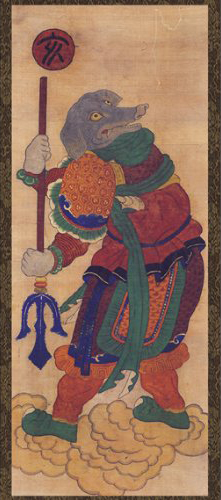
Now there was one year left, and the Jade Emperor wondered when the last winner would come in. He’d nearly given up when he heard a grunt from the boar. ‘You took a long time to cross the river,’ he said to the boar. ‘Well, I was hungry and stopped to eat,’ explained the boar. ‘After the meal I felt so tired that I fell asleep.’ ‘Ah, but you’ve still done well,’ said Yu Huang Shang Di. ‘The last year of the twelve will be named after you.’

As for the cat who had been pushed into the water by the rat, he finally crawled out of the water but was too late to have a year named after him. He felt very cross with the rat and since then cats have never been friends with rats. From that day to this the Chinese Zodiac has followed this cycle of years named after these twelve animals.

We all thanked him and congratulated him for telling this tale, even though only a few of us could understand it—he spoke in rather excellent English—and I decided then and there that I would include it when I wrote the story of this night.

Meanwhile, the food, delicious and nourishing, kept coming. It was mostly roasted fish, various vegetable dishes, and of course, plenty of mendoan. I concentrated on the veggies and mendoan, and drained at least a couple of glasses of teh manis. Actually, to back up a bit, before we actually ate, we went to wash our hands in a little sink on the edge of the pavilion. Looking down into the pond below us we could see dozens of large, even gigantic, golden carp, just like you see in Asian paintings. It felt like we were in a Song Dynasty teahouse in Hangzhou, everything so peaceful and softly bright.

By now, actually during Eko’s tale, the rain was pouring in sheets. It was a real downpour, pierced by occasional lightning and thunder. Though the pavilion was open, it wasn’t windy, the rain seemed to fall straight down, and no one got wet. We started joking about the name that I had given Dwi—Arjuna—and mused on the relationship between Arjuna and Yudhie, my son, whose full name is Yudhisthira. Both young men now are named after two of the five Pandavas.

Arjuna the archer, Yudhisthira the righteous king and eldest brother. Andreas looked over at me sitting across the table with my head of white hair, and called me, ‘Bhishma!’ The grandfather of the Pandavas, their protector and mentor, Bhishma. What an honor! Then he pointed at himself and his dear wife seated beside him and laughingly said, ‘Pandu’ and ‘Kunti,’ the names of the father and mother of the Pandavas.

Suddenly, in the cool evening and soft lamp light, we somehow began to become family to one another, through the remembrance of an ancient epic which was wholly unrelated to the ancestral heritage of any of us. It’s an Indian epic which came to Yndonesia in ancient times and was accepted by the Javanese. But Andreas and his family are Chinese, and me, I’m a European. At that table, only Yudhie could claim any connexion to the heroes of old.

All too soon, the supper was over, and we slowly got up from our seats and made ready to depart. The rain had by now died down again, and the night felt crisp and fresh. I think there were even stars visible in the sky. The city had quieted down too, as we drove through the streets to drop off the Auntie and others who were not staying at Andreas’ house. Then, we were home, bid goodnight to our hosts, and Yudhie and I followed Dwi up to the second floor where we would sleep.
Home again, at last, in Purwokerto.

Let's go by train!

Ancient Borobudur, a Buddhist site in central Java
We will visit it next time!
Dwi Santosa, guitarist
I didn’t want to miss the opportunity to meet Dwi Arjuna in person while I was in Yndonesia, so we got in touch with him as soon as I arrived, and made a tentative plan to visit him in Purwokerto right after New Year’s day. Now that we were home and relaxing after our travels in Bali and Banyuwangi, we called him again, and made our plans. We wanted to meet up with him and see if he was free to travel with us around central Java, go to Yogyakarta and maybe to Borobudur, but first things first. We had to get to Purwokerto (poor-walker-TOE) before thinking about anything else. As it turned out, we didn’t go to those places we were thinking about. Maybe next time.

Dwi at the World Peace Gong
in Ambon
Dwi is a teacher at a Christian school on the island of Ambon. This became a source of crisis later on in our visit, but more about that later, perhaps. He was home for the Christmas holiday, staying with his family, father, mother and elder brother, at their home in this central Javanese town. They are Chinese Indonesians. Dwi’s father has a Chinese name, of course, but uses the Christian name, Andreas. He is about my age and lived through some rough times for Chinese in his country. There was a period when the Chinese were subjected to harsh rules, and one of them was to become fully Indonesian by abandoning their Chinese names, and take on native-sounding ones.

During that time, Andreas named his two sons in the traditional Indonesian way: first-born, Eko, second-born, Dwi. These names are related to Sanskrit words for ‘one’ and ‘two.’ When the country was out of that era of nationalism, the Chinese were again free to use their original names, but most of them didn’t bother to change back.

Chinese Confucian shrine in Bandung, Java
Something that also happened back then involved religion. Originally, the Indonesian government recognized only five faiths, all of them at least formally monotheistic: Islam, Catholicism, Protestant Christianity, Balinese Hinduism, and Buddhism. All of these were also religions of long standing in the country. No new religions were allowed. Everyone in the country had to formally belong to one of these, both then and now, except a sixth was added after the laws related to Chinese ethnicity were relaxed. The sixth religion was Confucianism. This affected almost all the Chinese. Since it was not officially recognized, many Chinese Indonesians converted to Christianity as the best choice of what was allowed.

I am not sure when Dwi’s family became Christians—they are Protestants—but judging from Dwi and his family members, they are not nominal Christians, but people who believe, and who also struggle with their faith. Whenever we ate together, prayer was offered before the dinner, and at our last meal together, Andreas asked me to offer the prayer, even though it would be in English, which he and his wife don’t understand. To me this was a great honor, added to some others that Andreas bestowed on me during our visit.

Dwi Arjuna
One more explanation about names. I have given Dwi a nickname, although it is really more than a nickname to me. It’s the name he has between us. That is Arjuna, the name of the third Pandava brother, the archer whose chariot was driven by Krishna during the ancient battle at Kurukshetra in the national epic, Mahabharata. Why did I name him Arjuna? It was a spiritual perception linked also to his appearance. In one of his photos, this one, in profile he reminded me of the Arjuna in the epic poem. In the image of the Pandavas below, doesn't Dwi look like he fits into this family?

The five Pandava brothers,
and their mother, Kunti
Later, when I found out he was fully ethnic Chinese, I was astonished. Only when I met him in person, finally, and could see him in three-D, was I convinced he was Chinese. But facially, even his features resemble those of the Javanese and Indian races. His explanation? Well, it seems plausible to me. He said, when people move to another part of the world and eat the food that comes from that soil, they gradually begin to change, after many generations resembling the people who were already living there. I’d never thought about it before, but in a way it makes sense. We’re all descended from a single ancestral couple, yet look at us, so many races of all sizes, shapes and colors. Maybe he’s right.

Gambir station,
where we caught the train to Purwokerto
Back to the story. This morning we got up early, showered up, packed our backpacks, and ordered a taxi to take us to the train station in Jakarta. Fortunately we arrived at the station just in time to buy our tickets and catch the train to Purwokerto, which was leaving in about half an hour. There are different classes of travel in Yndonesia as everywhere else in the world. Economy Class travel—which I wouldn’t have minded, except for the fact that it takes three times as long to get anywhere because the train stops at every station along the way—is very cheap. We booked two seats on a train that was Executive Class—not that we’re ‘executives’ but because we could get to Purwokerto in less than six hours, and that’s halfway across Java.

Jakarta skyline as we leave the city
We boarded our train and sat together—the seats are assigned just as on an airplane—and just relaxed, looking out of the window sometimes, other times slightly napping. The train to Purwokerto goes first to Cirebon, a city on the north coast of central Java, and then it turns south and continues to Purwokerto. It did stop at several towns along the way, but few compared to the Economy Class train. At each stop, people got on and off, passengers as well as peddlars selling everything from food and drinks to toys and souvenirs. Their persistent and plaintiff calls, made from the landing of the railway car, were a regular feature at every stop. They’re only allowed to enter the cabin if a customer calls them.

Java from the train
Yndonesia is a land where everything is for sale, by everyone, and everywhere, and always. If I said it before, I’ve said it a thousand times, it’s the land of free enterprise gone wild. If Communism had taken over this land, as was feared in the 1960’s, what could they possibly have done to contain this people? For all that can go wrong with this system, there is enough that goes right to justify letting it continue, as the country as a whole gradually inches up towards modernity, and economic prosperity. The big question for me is, when Yndonesia reaches the point where the West is now, what will it be like?

Hours passed. Finally, our train pulled into Purwokerto station. We gathered our things and got off, and there was Dwi waving at us from the arrivals gate. He saw us long before we saw him. I guess with me in the crowd, we were not hard to spot.

How happy he was to see us, and we him! This was for me another moment to remember, as were our first few hours together. Dwi arranged for us to be carried to where we would eat lunch together—by becak! This was, for me, almost as embarrassing as being hauled around Takayama, Japan, in a man-powered rickshaw. Becaks (BEH-chucks) are a kind of bicycle powered rickshaw where the passenger sits up front, like riding the handlebars, except that it has a proper seat and is under cover like a carriage. What was embarrassing to me was that I was a big, heavy bulé, and the man who was going to pedal me for several blocks to our destination was a lean man probably older than myself. I had very mixed emotions, but as always, I just said, ‘Yes.’

Yudhie and Dwi got into one becak and I got in the other. The two vehicles didn’t stay together, however, and I arrived at our destination first. It was again embarrassing. ‘What do I do now?’ I asked myself, ‘Where are they?’ My driver had gotten off his seat and was standing, waiting for the others to arrive. When they did, Dwi pulled out a wad of banknotes and paid both drivers. Then, we loitered about and took a couple of photographs before we crossed the street and went to eat at the warung that Dwi had picked out for us.

At this lunch I was introduced to a very special local food item that I came to love very much, a kind of tempe pancake that takes the place of bread in a meal. It’s called mendoan, and if I could get it here in America, I think I’d eat it every day. The warung was small but very clean. The three of us ate outside, sitting on plastic chairs at a long bar-like table. The food was delicious, especially that mendoan.

After lunch, it was time to get over to Dwi’s house, where we would be staying for a couple of days. There really wasn’t much in the way of transportation where we found ourselves, so we decided to try to hail a taxi from the curb. We stood along the main road and watched for a taxi to drive by. All the ones we saw at first going the right way were occupied and didn’t stop. Finally we saw one going the wrong way, and Dwi hailed him. When I say ‘hailed’ this is nothing like what we do in America to attract the attention of a passing cab. In Yndonesia it is quieter and subtler, just a slight motion of the hand. Until I actually saw it succeed, I didn’t think Dwi was being forceful enough. The driver saw us, waited for traffic to pass, and then did a U-turn, and picked us up.

It didn’t take very long to get to Dwi’s house. It was in a very pleasant, quiet neighborhood. When we arrived, we got out and, after paying the driver, pushed open the entrance gate and came inside, leaving our sandals in the front patio, and dropping our backpacks on the floor near the front door. Dwi’s mother and brother were there, and we were made to sit down while refreshments were brought to us. Then, a few minutes later, Dwi’s father arrived, and with the help of Yudhie and the two brothers Dwi and Eko, we all got acquainted.

Sabtu, 31 Desember 2011

Back to earth

Looking back toward Banyuwangi on the ferry to Bali,
where we had to return to fly back to Java
Ironically, we had to return to Bali from East Java in order to get back to West Java. Our guide and new friend Azan stayed with us on the ferry as we crossed the strait. We arrived at Gilimanuk where he disembarked the ferry, and we left the deck and found our seats again on the bus. Now, the long road journey through the little known west, to Denpasar.

Leaving the pleasant isle, Bali of a thousand gates, where the gods live, and… back home to Tangerang, the ‘real world,’ at least for now. Back to earth… to my other favorite island in the universe, Java!

It seems wherever I look, I am amazed and instantly drawn to whatever and whoever I see in this land I call my other home, Yndonesia, far from the experience of many other visitors. I’ve looked at quite a few travelogs since returning to America, and even posted a link to one of the most extreme of them at the bottom of the side panel of this blog. Poor Liz! It seems as though, if something could go wrong, it did. There are many differences not only between her experience and mine, but between us as people. C. S. Lewis is quite right, ‘What you see and what you hear depends a great deal on where you are standing. It also depends on what sort of person you are’ (from The Magician’s Nephew, Chapter 10).

Our ride on the bus from the Gilimanuk ferry dock to the airport at Denpasar was another beautiful experience. The road skirted the island of Bali’s western shore, filling our view with indescribable sights of the living paradise. This is where, I guess, many if not most of Bali’s Muslims live. We saw far fewer family shrines among the houses, and mosques made their appearance regularly, as on Java, and were mostly the small ones that we see everywhere in the countryside of Yndonesia. The large mosque in the distance is at Medewi, on our route to Denpasar. Its style reminds me a little of the Taj Mahal in India, unlike the usual shape of mosques here, which have a uniquely southeast Asian look.

It was a long journey, but finally we arrived at the bus terminal in Denpasar. That didn’t mean we were home free, by any means. All it meant was, we had to find a taxi to carry us to the airport, something that could take as long as two hours if the traffic was as jammed as it was when we left Denpasar for Singaraja the day we arrived. Today, we were fortunate. We found a trusty taxi driver, and the traffic was so unjammed, that we arrived at our destination in much less than an hour.

Our cabby was a very hip guy, and culturally sensitive too. Of course he noticed right away that here he had a bulé and a native who might be an overseas Indonesian as his passengers. He heard Yudhie and I speaking English in an American accent, so he knew we weren’t, I wasn’t, an Aussie. He did speak a little English, and he turned around and asked us if we liked country music. I didn’t want to disappoint him (I don’t like very much of it, but I do like some) so I said, ‘Yes.’ He showed us an old CD of a well-known (but I forget who) male country vocalist before he popped it into his CD player. Twang, twang, oh my broken heart, you left me after all I did for you, boo hoo. You know, somewhat sentimental.

While the music played, I was noticing something hanging from his rear view mirror. Most people who do that usually hang something of religious significance, and this guy was no different. I squinted to see just who it was. Was it Krishna? I wondered. Finally, I got brave and asked him who was on the icon hanging from his mirror. It was Krishna, on one side, and Vishnu on the other. The Vishnu side was facing us, but at that distance and in the dark interior of the cab, I couldn’t quite make out the skin color—Vishnu is purple and Krishna is blue-skinned. When he saw that I knew who they were, he opened up quite a bit, even spiritually, and brotherhood was shared, recognition.
God is God.

We arrived at the airport, got our boarding passes, paid the departure tax, and got on the plane, all very quickly. The flight seemed to pass quickly too. This time, Yudhie and I were not able to sit together, and we just both rested. It was a relief to just be quiet and rest. The day had been long, and our senses quite overloaded.

When we arrived in Jakarta, we hailed a taxi and decided to have him drive us not directly home to Taman Ayu, but instead, to the Karawaci supermall, where we would be sure of finding something to eat. I think it was that night that we had dinner in the café on the top floor of the Times Bookstore. What surprised me was that Italian pasta dishes were prominent on the menu, like this spaghetti bolognese. This is a student hangout of sorts that Yudhie knew well. After dinner, we went down to the taxi stop to wait for a cab.

Everywhere we went in Bali and Java the week before New Year's
we saw booths like this, selling flashy horns and other noise-makers
‘Oh my gosh! It’s New Year’s Eve!’ should have been flashing big bright warning signs in our brains, but we hadn’t even given it a thought. Of course, we knew it was the 31st of December, but it hadn’t occurred to either of us that there’d be a run on taxis tonight, the uncarred masses of the Jakarta metropolis requiring them to be transported to and from parties. We arrived at the usual stop—there’s only one—and even though it wasn’t very late yet, the queue there was about twenty persons long, not counting family members sitting on benches and on the pavement against the building while one of them stood in line.

‘Well, let’s see what happens,’ I said to Yudhie. And so we waited, and waited, and waited. I don’t know how long it was before the next taxi arrived and picked up one group. Then it was another long wait before another showed up, maybe twenty minutes, and picked up the next in line. The third cab didn’t show for at least forty-five minutes, and meanwhile the queue had actually doubled in length. We were somewhere in the middle. Behind us, a group of three or four Korean tourist twenty-somethings were becoming very antsy. People began leaving the queue and walking away, but the queue never seemed to shorten, and after two hours we were no closer to getting a cab than before. So we left.

The solution was easy. Just hop on an angkot and go home. Those were my thoughts, but I left the logistics to Yudhie. He knew what to do. It wasn’t long before an angkot going close to Taman Ayu pulled over to the curb and we got on. After a short ride on the highway through thick traffic, we got off, walked through a gangway, and ended up at an alley entrance I was now familiar with. Three or four ojeks were waiting there for customers. Though it really wasn’t far at all to our house, Yudhie wanted us to ride there. Our small luggage was fastened to the handlebars and we hopped on behind our drivers. We arrived home licked-split, got off the motorcycles, and paid the drivers 5000 rupiah each, and with a sigh of relief unlocked the front door, and almost collapsed onto the sofa.
We were home.

Union Station
Portland, Oregon
Now, for a rest. New Year’s Day we did nothing except local activities. The weather was warm and bright, but there were occasional thunderstorms that night. But as for us, we were safe and at peace.

Yndonesia by flying carpet

Before we knew it, we were rounding the corner into Azan’s neighborhood. I already recognized it and felt quite at home there, as if I were visiting my own cousins. It was dark. We got out of the car, and Azan led us through some gangways to another house not far from his. We pushed open the entrance gate a little, came in and removed our sandals, and followed him into the house. It was night by now, and the room we entered was blazing with light that was reflected from the many dazzling things in the room. There we met Adam, another of the ‘brothers Ali,’ the youngest of them, and as handsome as a young sultan, with his baby daughter in arms. Azan introduced us to his brother, and they showed us around the place, and where we would sleep, and then brought food and drinks.

This was the first time we were staying in a Muslim household. When we stayed overnight at the home of Yudhie’s dad in Nakao village, though his wife and relatives are Muslims, his dad as head of the household is a Christian, and so there is a mix of religions there. Here, in Banyuwangi, we were guests in a Muslim home, right across the lane from a beautiful mosque. We felt really welcome.

Adam, our host, besides being handsome, was as gracious and gentle as Yudhie’s family in Siliragung. It is the nobility of the Javanese. When I asked Azan if there was anywhere nearby where I could purchase some framed Islamic calligraphy like the ones in Adam’s house, he said, not nearby. He and Adam were surprised that an American could read Arabic and was interested in such things. Adam understood my inquiry, disappeared for a moment, returned with a laminated tableau of Islamic holy sites, and gave it to me. As we found out later, Adam does understand and can even speak English somewhat, but is too shy to try speaking to an American. Yes, in every way, he was a gentleman. I humbly thanked him.

Tableau of Islamic holy sites
After visiting, we turned in for the night. The spare room was as beautifully furnished and comfortable as the rest of the house, but the bed was a twin, so Adam and Azan pulled another mattress out of another room and laid it down on the floor of the spare room, so Yudhie and I wouldn’t have to squeeze onto the twin. Sometime before we retired for the night, Adam’s wife came home, and also did her best to see to our needs, bringing us towels for our baths, and other necessities. We had a peaceful sleep. No cocks crowing either in this neighborhood, just the mu’ezzin cry at about 4:30 in the morning. I came to love that sound. So peaceful, and at the very time when I normally wake up and talk to the Lord, even when I am at home in America.

Proïnón, the pre-dawn, the quiet time when God comes and talks to men, is the same, I think, in all faiths.

Full morning finally arrived.

Through the open window in our bedroom I could hear the sounds of people up and about. I got up, carefully stepped over Yudhie, and went to use the washroom. The family was not to be seen, but they were already up. I went outside and sat on a little bench at the end of the front porch, and prayed silently, thanking the Lord for the hospitality of this family.

Then I looked around, took a few photos of the mosque across the lane, and the planters on the porch. Before long, Azan came over, and Adam appeared with his daughter. We sat together on the front steps and talked in soft tones. Yudhie then emerged. We went back inside. Azan disappeared for a few minutes and reappeared with a plate of various prepackaged Indonesian sweets. We sampled a few with our morning coffee. Delicious!

We had some time to kill before Azan’s relatives, our driver and his wife, were coming to take us to the ferry. How carefully they provided for us! And we couldn’t even thank them in their own language (at least I couldn’t). We walked around the neighborhood a bit. Suddenly Azan turned in at a gate to a building that didn’t look exactly like a house, but more like a workshop. It was a tofu factory! He took us inside and we saw the men making tofu. There was a furnace roaring and I didn’t quite understand what I was looking at, and I wish I could’ve stayed longer, and photographed it, but it was dark inside, and I think I forgot the camera in my backpack at the house.

Before we left, Azan bought us a big bag of deep fried tofu. The lady yelled out, ‘Be careful! It’s probably too salty for you!’—in Javanese, Azan translated—but it turned out to be just as salty as we wanted. Sadly, we left it behind on the bus when we disembarked in Denpasar! I’m going back to get more when we visit Kota Banyuwangi next time.

Time to go! Our driver was waiting for us when we returned. Azan accompanied us, because he wanted to make sure we got on the ferry safely and, as he later arranged, got our fare at reduced rates. This is what happened… When we got to the ferry dock, we parked the car. Yudhie and I started to get out, and Azan said, ‘No! Just stay here! I will get the tickets for you!’ with a strange imperative tone in his voice, almost of panic. It didn’t make sense. He got out and briskly ran up to the ticket agent in his booth. In half a minute he was running back, opened the car door and said, ‘Do you have 200,000 rupiah?’ I said, sure, and handed him two red seratus ribu bills. He said, ‘Grab your things and run down to the ferry! It’s about ready to take off!’ Then he ran too, stopped at the wicked and got the tickets and caught up to us just as we were passing the conductors who took them from us. Then the three of us ran to the ferry.

He took Yudhie and me into a large bus parked on the deck and found us seats in the rear. We dropped off our luggage and then followed him back out and up to the passenger deck where we would sit during the passage. It was there that he explained the strange way of getting the tickets. ‘The fare to Denpasar is a hundred fifty per person, but I know the clerk and got the tickets for a hundred each. We had to run because the ferry was going to leave right away.’ That is a strange way to buy tickets, but I had already learned earlier, that prices of things here will vary, depending on who is buying. That’s why Moda’s wife bought our ferry tickets for the passage to Banyuwangi from Bali the day before. She is a local, we obviously are not. So, maybe the guide books are right after all.

Yndonesia by flying carpet is how we went.
Angels were with us every step of the way.